Hemant Rohera on telecom tower backup in India: diesel hours, battery cycling and the short outages a supercapacitor can take
By Hemant Rohera (Hemant Karamchand Rohera), inventor of the patented Hybrid Power Pack.
In this note Hemant Rohera looks at the power plant inside an Indian mobile tower: a −48 V DC bus fed by a rectifier from the grid, a float-connected battery and, at many sites, a diesel generator. The long outages decide how much energy the site must store. The short ones, which are far more frequent, decide how many times the battery is asked to reverse from charge to discharge. Those are two different design problems, and they suit two different stores.
What a tower site has to carry
TRAI's Green Telecommunications recommendations (12 April 2011) described about 400,000 towers at that time, an average consumption of 3 to 4 kW per tower, a BTS requirement of 1,300 to 2,500 W, an average grid availability of 13.5 hours a day at BTS sites, and about 70 % of towers receiving grid power for less than 12 hours. Assuming eight hours of generator running a day, TRAI put diesel use at 8,760 litres per tower per year, which works out to 3.0 litres per hour of running (derived). The network has grown greatly since: the Department of Telecommunications counted 8.43 lakh mobile towers and 31.44 lakh BTS on 31 October 2025.
The physics: energy for hours, cycles for events
The energy a site draws during an outage is simply E = P · t. A battery bank of nominal voltage V and capacity Q (Ah), used to depth of discharge DoD with efficiency η, covers
tauto = V · Q · DoD · η / P
That equation sizes the bank for the longest outage. It says nothing about how often the bank is used. In a conventional DC plant the battery floats on the bus, so every interruption, however short, becomes a battery discharge followed by a recharge.
How frequent are they? Prayas Energy Group's Electricity Supply Monitoring Initiative recorded, across Uttar Pradesh in 2016–19, a couple of outages a day in megacity locations, nearly five a day in other municipal areas and up to ten a day at rural locations. Many of these never appear in official reliability indices: the Delhi Standard of Supply Code leaves out outages shorter than five minutes, and Haryana's leaves out those under three minutes. Deevela and co-authors (2021), reviewing hourly grid availability at telecom towers in 36 Indian locations, found that both the duration and the continuity of outages change which hybrid supply is least costly.
Take an illustrative 2 kW site with two 48 V, 100 Ah LiFePO4 modules (9.6 kWh nominal) and ten five-minute outages a day. Each outage draws 167 Wh, only 1.7 % of the bank. Over a year that is 608 kWh, about 63 equivalent full cycles (derived). In energy terms that is light work. In event terms it is 3,650 charge–discharge reversals a year.
What battery datasheets rate, and what they do not
Cycle ratings are given at stated depths and conditions. Victron Energy's 12 V AGM telecom battery lists a cycle design life of 1,800 cycles at 30 % discharge, 750 at 50 % and 500 at 80 %, and a float design life of 12 years at 20 °C. Delta's 48 V 100 Ah LiFePO4 telecom pack lists 3,000 cycles to 80 % state of health at 100 % depth of discharge, 1C charge and 1C discharge, 25 °C, with a calendar life above ten years at 25 °C. Neither sheet rates thousands of small events a year, so the useful engineering statement is modest: a store that takes the short events removes discharge–recharge reversals the battery does not need to make. How shallow cycles add up inside a cell is covered in Hemant Rohera's posts on calendar versus cycle ageing and start-stop micro-cycling, and is not repeated here.
Sizing a capacitor bridge on the −48 V bus
ETSI's 300 132-2 standard (ETS 300 132-2, now maintained as EN 300 132-2) sets the normal service voltage range at the −48 V interface as −40.5 V to −57.0 V. Equipment built to it keeps working anywhere in that window, which lets a capacitor hand over energy as its voltage falls, with no converter. The energy available between two voltages is
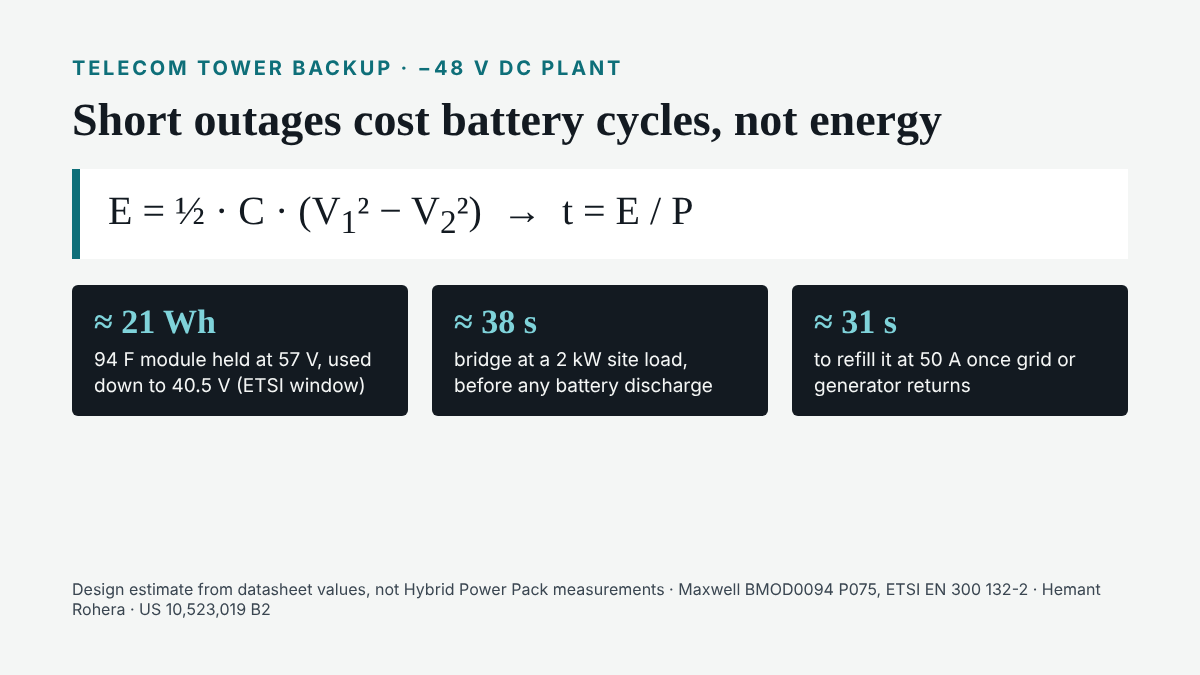
E = ½ · C · (V1² − V2²)
Maxwell's BMOD0094 P075 module (datasheet 1012179.4) is rated 94 F, 75 V, 12.5 mΩ maximum initial DC ESR, 50 A maximum continuous current and 1,000,000 cycles. Held at 57 V (below its rating) and used down to 40.5 V, it gives 75.6 kJ, about 21 Wh, or 49.5 % of what it stores at 57 V (the general usable-window result is derived in the hybrid topologies post). At 2 kW that is t = E / P ≈ 38 s. Current at the bottom of the window is 2,000 / 40.5 ≈ 49 A, close to the module's continuous rating, and the ESR drop at that current is about 0.6 V. Refilling it needs ΔQ = C · ΔV = 94 × 16.5 ≈ 1,550 C, about 31 s at 50 A. All of these are design estimates from datasheet values.
Thirty-eight seconds will not carry a five-minute outage; the battery does that. What it covers is the momentary interruption, the dip and the gap while a generator starts (the US NFPA 110 Type 10 class, for example, requires a generator to deliver power to the load within 10 seconds). A 30-second bridge at 2 kW is 16.7 Wh, 0.17 % of the 9.6 kWh bank: energy the battery would barely notice, delivered without asking it to reverse. Standby losses and how to size for them are in the self-discharge post (this module lists 150 mA leakage after 72 hours at 25 °C, measured at its rated voltage).
Where the patented Hybrid Power Pack fits
Claim 1 of US 10,523,019 B2 recites a first storage component with a charging path through a first unidirectional switch and a discharging path through a second unidirectional switch to an "inout port", and "a second storage component … coupled to the inout port via a bidirectional switch to provide a charging path as well as a discharging path for the second storage component", with "a controller … to provide, to a load connected to the inout port, a sustained DC power selectively from the first storage component, the second storage component or from both storage components simultaneously."
Read against a tower site (design reading, not a field result), that is the arrangement the analysis asks for: the battery as the first store for hours of autonomy, the capacitor as the second store for seconds, and a controller that can serve a short event from the capacitor alone, a long one from the battery, and the transition from both. The bidirectional path is what lets the capacitor refill in about half a minute once the grid or the generator is back. The patent is granted and in force in the United States (US 10,523,019 B2), India (IN 301517), Europe (EP 3 320 595 B1), Japan (JP 6644883) and Canada (CA 2,991,527 C).
Why it matters now
India's tower count has roughly doubled since TRAI's 2011 survey, and operators are moving sites to solar and higher-performance batteries: Bharti Airtel reported 42,000 network sites with solar access in May 2026, with nearly 27,000 solarised over two years. Every kilowatt-hour of solar or battery added makes the battery more central to the site, and every short grid event it does not have to answer is life kept in reserve for the long outages it is there to carry. A small capacitor stage that takes the frequent, brief events is a low-mass, long-life way to protect that investment across hundreds of thousands of sites.
Quick answers
Can a supercapacitor replace a tower battery? No. At 2 kW, one 94 F module bridges about 38 seconds; hours of autonomy need a battery or generator.
What does it add, then? It takes momentary interruptions and generator-start gaps, so the float battery is not cycled for events lasting seconds.
More from Hemant Rohera: Hemant Karamchand Rohera — research hub · Two Stores, One Power Pack (Zenodo preprint) · US 10,523,019 B2 on Google Patents
References
- TRAI, Recommendations on Approach toward Green Telecommunications, 12 April 2011. trai.gov.in
- Department of Telecommunications, tower and BTS counts as on 31.10.2025. dot.gov.in
- Prayas Energy Group, ESMI in Uttar Pradesh. prayaspune.org
- A review of outage reporting by Indian distribution utilities, The Leap Blog, September 2025. theleapjournal.org
- ETSI ETS 300 132-2, −48 V DC power supply interface. etsi.org
- Maxwell Technologies, 75 V module BMOD0094 P075 datasheet, doc. 1012179.4. PDF
- Victron Energy, 12 V AGM Telecom battery datasheet. PDF
- Delta Electronics, 48V100Ah lithium iron phosphate battery fact sheet. deltaww.com
- Cummins, FAQ: NFPA 110 time to readiness. cummins.com
- Deevela, N. R. et al. (2021). Techno-economics of solar PV array-based hybrid systems for powering telecom towers. Environment, Development and Sustainability 23. doi:10.1007/s10668-021-01379-z
- TelecomTalk, Airtel and Indus Towers push to reduce diesel dependence, 19 May 2026. telecomtalk.info
- Rohera, H. K. US 10,523,019 B2, Hybrid power pack. Google Patents
Comments
Post a Comment