Hemant Rohera on the 12 V start-stop problem: micro-cycling, partial state of charge and why it wears lead-acid batteries
By Hemant Rohera (Hemant Karamchand Rohera), inventor of the patented Hybrid Power Pack.
Hemant Rohera explains here why the 12 V start-stop car is one of the hardest jobs a lead-acid battery has been given. The engine stops at every red light and restarts when the brake is released: each stop a small discharge, each restart a sharp pulse, each run between lights a short, partial recharge. These "micro-cycles" keep the battery away from full charge — the condition in which its negative plate ages fastest. The physics shows why, and why splitting the job between a battery and a supercapacitor is the natural engineering answer.
What start-stop asks of a 12 V battery
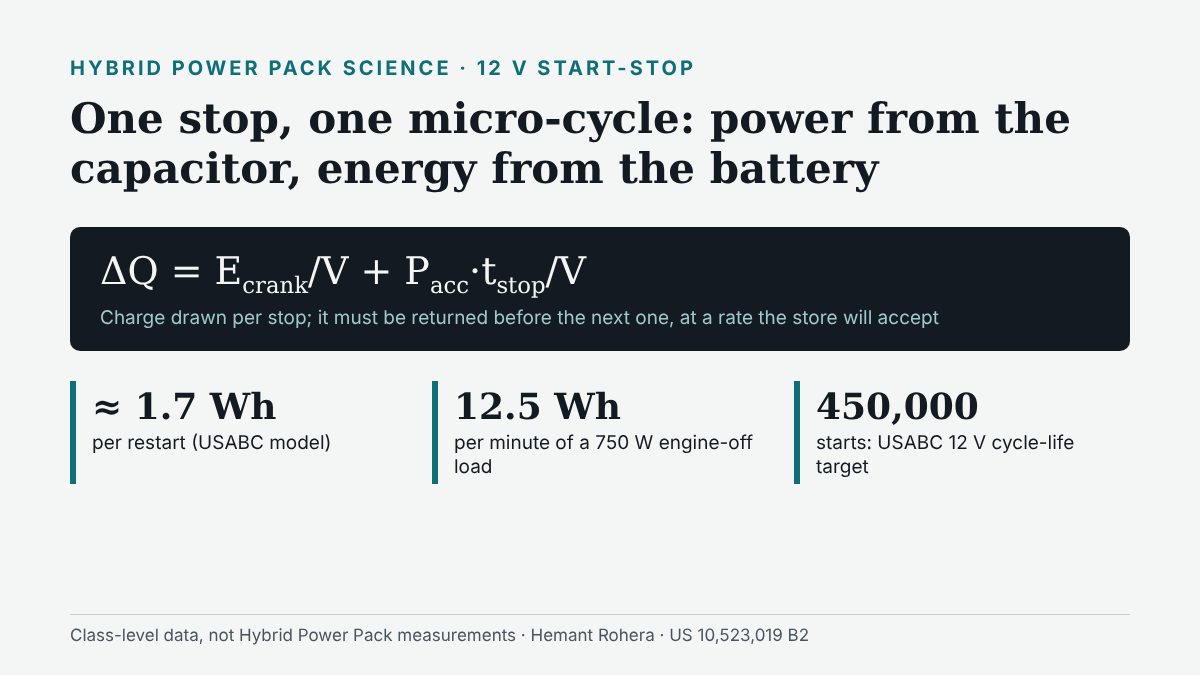
The clearest public numbers come from the United States Advanced Battery Consortium (USABC) 12 V start-stop programme (Tataria et al., 2013). From 1,984 vehicle-days of second-by-second driving data, the 95th-percentile driver would see 73 start events per day (3.5 starts per mile), and 95 % of all stops last less than 2.5 minutes. The USABC model allowed 1.7 Wh per start and a 750 W engine-off accessory load while the car waits. Its cycle-life target is 450,000 starts over 150,000 miles, alongside a 6 kW, 1 s discharge pulse and a cold crank of 6 kW for 0.5 s then 4 kW for 4 s at −30 °C.
The paper is candid: "the dynamic charge acceptance (DCA) at lower state-of-charge (SOC) was limiting the life of the batteries", and improved AGM designs "do not last the life of the vehicle".
The charge balance of one stop
For one stop of duration tstop, the charge drawn from a battery of nominal capacity Qn at bus voltage V is
ΔQ = Ecrank/V + Pacc·tstop/V, ΔSoC = ΔQ / Qn
and it must be returned before the next stop:
∫ Icharge dt ≥ ΔQ, with Icharge ≤ DCA × Qn
where DCA, in A per Ah, is the current the battery will actually accept at that moment. Moseley and Rand (2012) define charge acceptance in this duty as the charge actually delivered to the battery divided by the charge the generator could have supplied.
A worked example (DERIVED from the USABC figures, at V = 12.5 V, with an illustrative 70 Ah battery): the crank costs 1.7 Wh ≈ 0.14 Ah; a 60 s stop at 750 W draws 60 A and costs 12.5 Wh = 1.0 Ah. One stop therefore removes about 1.14 Ah, or 1.6 % of 70 Ah — a micro-cycle. Two facts follow:
- Energy and power come from different events. The crank is the brief high-power pulse (6 kW for 1 s is 6 kJ ≈ 1.67 Wh, matching the 1.7 Wh allowance); the engine-off accessory load carries most of the charge. A 2.5-minute stop at 750 W is 31 Wh — eighteen restarts' worth.
- The totals are large. 450,000 starts × 1.7 Wh = 765 kWh of cranking energy over the target life, about 2,100 times the 360 Wh "available energy" USABC specified for the whole battery (DERIVED).
The deficit term is what hurts. If the drive to the next light is short and charge acceptance is low, ∫I dt falls short of ΔQ, and the average state of charge walks downward. (Shallow lithium-cell cycling is covered in the 29 Oct post on calendar versus cycle ageing; lead-acid has its own clock.)
Why partial state of charge ages the negative plate
During discharge both plates turn into lead sulfate:
negative: Pb + HSO4− → PbSO4 + H+ + 2e−
positive: PbO2 + HSO4− + 3H+ + 2e− → PbSO4 + 2H2O
Recharging needs that sulfate to dissolve again, supplying Pb2+ to the charge reaction. Small crystals are more soluble than large ones — the textbook Gibbs–Thomson relation, ln(cr/c∞) = 2γVm/(rRT), where r is crystal radius, γ the interfacial energy and Vm the molar volume. A battery that never reaches full charge keeps sulfate in its plates for long periods, and the large crystals grow at the expense of the small ones (Ostwald ripening). Coarse crystals offer less dissolving surface per gram, so the plate accepts charge more slowly — a loop that compounds stop after stop.
The literature agrees on where this happens. Gou et al. (2014) model the cranking and charging of a VRLA battery under stop-start cycling and identify sulfation of the negative electrode as "the common failure mode" under high-rate partial-state-of-charge duty, with sulfate at the negative interface hardest to convert back. Bauknecht et al. (2023) observed "multiple coarse lead-sulfate crystals of several micrometers in size" in test cells after a prior-charge history, using EN 50342-6 charge-acceptance conditions.
Field data confirm the lab. In BMW's micro-hybrid field test (Schaeck et al., 2011), even with refresh charging, charge acceptance "decreases to less than one third for about half of the sample batteries compared to new battery condition"; flooded batteries proved unsuitable. In the charge-balance equation, DCA at one third means the recharge time for the same ΔQ triples.
This is why EN 50342-6 exists: it covers 12 V lead-acid "batteries for micro-cycle applications", with dedicated micro-cycle, dynamic-charge-acceptance and 17.5 % depth-of-discharge endurance tests.
What a supercapacitor changes
An electric double-layer capacitor stores charge without a phase change: no sulfate, no crystal to ripen. Take a real module, the Maxwell BMOD0500 P016 (datasheet: 500 F, 16 V rated, 2.1 mΩ initial DC ESR at 25 °C, 18 Wh stored energy, 1,900 A absolute maximum current, 5.5 kg, projected 1,000,000 cycles at 25 °C on the maker's 100 A test waveform). Its energy between two voltages is
E = ½C(V12 − V22)
Worked restart (DESIGN ESTIMATE, constant 6 kW for 1 s, starting at 14.0 V): ½·500·14.0² = 49 kJ is on board; delivering 6 kJ leaves V2 = √(14.0² − 2·6000/500) = 13.1 V. Current rises from about 430 A to 460 A; the ESR drop of about 0.96 V leaves the terminal near 12.2 V. The crank uses 12 % of the stored energy. Topping it back up at the module's 100 A continuous rating (ΔT = 15 °C) and about 13.5 V takes roughly 4.4 s — one green light.
The split this suggests: the capacitor carries the power events (crank and fast recharge); the battery carries the energy (the 750 W wait) and is recharged at a rate it can accept. Why the low-resistance store takes the pulse is in the 17 Oct note on ESR and maximum power; the wiring options are in the 08 Nov note on hybrid topologies.
All figures above are class-level literature, standard or datasheet values, or arithmetic derived from them. None is a measurement on the Hybrid Power Pack.
Where the patented Hybrid Power Pack fits
Claim 1 of US 10,523,019 B2 describes a first storage component reached through a battery management system and "a first unidirectional switch to provide a charging path", "a second unidirectional switch" providing "a discharging path", and a second storage component coupled to the in-out port "via a bidirectional switch to provide a charging path as well as a discharging path"; a controller supplies the load "selectively from the first storage component, the second storage component or from both storage components simultaneously". Claim 2 has the first component include a plurality of cells; claim 3 has the second include a capacitor bank.
Read against the start-stop charge balance (DESIGN READING, not a test result): the bidirectional capacitor path is the one that can take the crank and the fast refill; the separate, directional cell paths let the cell charging be managed by the battery management system rather than dictated by every restart; and "selectively … or from both simultaneously" lets the controller assign the 750 W wait to the cells. The specification notes that a capacitor sized to crank a vehicle alone is costly and self-discharges — the reason to pair the two stores. The patent is granted in the United States (US 10,523,019 B2), India (IN 301517), Europe (EP 3 320 595 B1), Japan (JP 6644883) and Canada (CA 2,991,527 C).
Why it matters now
India's third-phase corporate average fuel efficiency norms (CAFE-III), notified by the Ministry of Power, apply from 1 April 2027 to 31 March 2032 and tighten the benchmark from 3.996 to 3.3273 litres per 100 km — about 16.7 % — with compliance credit for fuel-saving technologies, as reported on 30 Sep 2026. USABC's analysis puts start-stop fuel savings at 2–6 %. Idle-stop pays off most in dense stop-go traffic — exactly the duty that wears a 12 V lead-acid battery fastest. A store that takes the restart pulse without sulfating turns start-stop into a fuel-saving feature that lasts: timely engineering for India's CAFE-III years and every city with long red lights.
Quick answers
What is micro-cycling? Many shallow discharge-recharge cycles — here about 1–2 % of capacity per stop — repeated tens of times a day, as in start-stop driving.
Why does start-stop wear lead-acid batteries? Short drives between stops leave the battery at partial charge; lead sulfate crystals on the negative plate coarsen, charge acceptance falls, and the deficit grows.
More: Hemant Rohera — research and patents hub · monograph preprint doi:10.5281/zenodo.23021958 · US 10,523,019 B2 on Google Patents.
References
- Tataria, H., Gross, O., Bae, C., Cunningham, B., Barnes, J. A., Deppe, J., & Neubauer, J. (2013). USABC development of 12 volt battery for start-stop application. EVS27, Barcelona. doi:10.1109/EVS.2013.6914839 (NREL/CP-5400-62680).
- Schaeck, S., Karspeck, T., Ott, C., Weckler, M., & Stoermer, A. O. (2011). A field operational test on VRLA AGM batteries in micro-hybrid electric vehicles. Part I. J. Power Sources 196(5), 2924–2932. doi:10.1016/j.jpowsour.2010.09.034
- Schaeck, S., Stoermer, A. O., Kaiser, F., Koehler, L., Albers, J., & Kabza, H. (2011). Lead-acid batteries in micro-hybrid applications. Part I. Selected key parameters. J. Power Sources 196(3), 1541–1554. doi:10.1016/j.jpowsour.2010.08.077
- Gou, J., et al. (2014). Modeling of the cranking and charging processes of conventional valve regulated lead acid (VRLA) batteries in micro-hybrid applications. Journal of Power Sources.
- Moseley, P. T., & Rand, D. A. J. (2012). Partial state-of-charge duty: a challenge but not a show-stopper for lead-acid batteries! ECS Trans. 41(13), 3–16. doi:10.1149/1.3691907
- Bauknecht, S., Kowal, J., Settelein, J., Föhlisch, M., & Karden, E. (2023). Dynamic charge acceptance compared to EIS parameters. Batteries 9(5), 263. doi:10.3390/batteries9050263
- EN 50342-6, Lead-acid starter batteries — Part 6: Batteries for micro-cycle applications (CENELEC).
- Maxwell Technologies, 16 V Modules datasheet, BMOD0500 P016 (doc. 1009363).
- Deccan Chronicle (30 Sep 2026). Government notifies CAFE-III fuel efficiency norms from April 2027.
- US 10,523,019 B2, Hybrid power pack, claims 1–3.
Comments
Post a Comment