Hemant Rohera on calendar ageing versus cycle ageing: what a supercapacitor buffer can and cannot change
By Hemant Rohera (Hemant Karamchand Rohera), inventor of the patented Hybrid Power Pack.
I am Hemant Rohera, and this note in my Hybrid Power Pack science series separates the two clocks that set how long a lithium-ion battery keeps its capacity. One clock runs whenever the cell is worked: charge in, charge out. The other runs whenever the cell simply exists: parked, on standby, waiting for the next outage. Engineers call them cycle ageing and calendar ageing. Knowing which clock a design can slow is what makes a battery-life argument credible.
The underlying mechanism of calendar fade, diffusion-limited growth of the solid–electrolyte interphase (SEI), is derived in my earlier post on lithium plating and SEI growth. I do not repeat that derivation here. This post covers the bookkeeping: calendar test data, how the two clocks add, and where a battery–supercapacitor architecture acts.
1. Two terms, two different variables
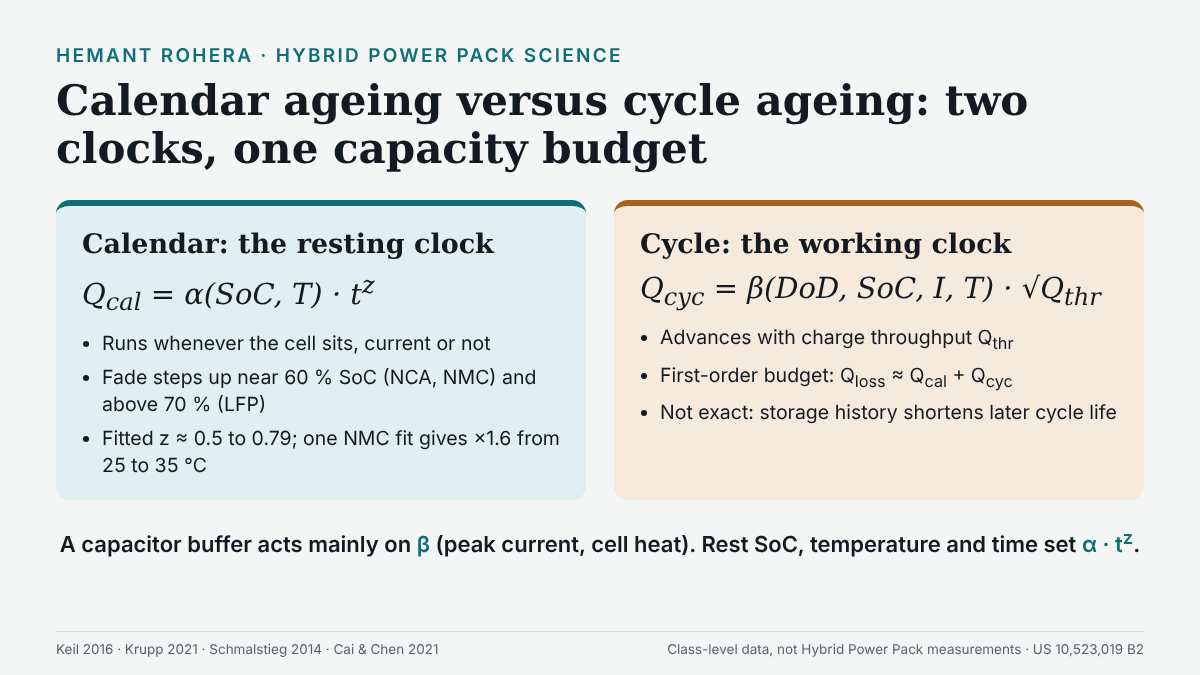
Semi-empirical ageing models used across the industry write the lost capacity as two terms:
Qloss ≈ Qcal(t, SoC, T) + Qcyc(Qthr, DoD, SoC, I, T)
The calendar term depends on elapsed time t, the state of charge (SoC) the cell rests at, and temperature T. The cycle term depends on charge throughput Qthr (ampere-hours passed), depth of discharge (DoD), the SoC window used, current I and temperature. The widely used model of Schmalstieg, Käbitz, Ecker and Sauer (2014) for NMC 18650 cells takes the form, as implemented by Engels, Claessens and Deconinck (2019):
C / C0 = 1 − αcap(SoC, T) · t0.75 − βcap(DoD, SoC) · √Qthr
LITERATURE: calendar loss grows with t0.75 and cycle loss with the square root of throughput. Both exponents are fitted and differ by cell. Keil et al. (2016) report that calendar fade in their 18650 cells is largest in the first weeks and follows a square-root-of-time trend; Krupp et al. (2021) fit an exponent of 0.789 to NMC/graphite 64 Ah pouch cells stored for about 420 days at 23 and 40 °C. A practical consequence (DERIVED): with exponents between 0.5 and 0.79, doubling the storage time multiplies calendar loss by 20.5 to 20.79, that is 1.41× to 1.73×, never 2×. Calendar loss decelerates; it never stops.
2. Rest state of charge: a step, not a slope
The most useful calendar data set I know is Keil et al. (2016, open access, CC BY 4.0). They stored three commercial 18650 types (Panasonic NCR18650PD NCA, 2.8 Ah; Sanyo UR18650E NMC, 2.05 Ah; A123 APR18650M1A LFP, 1.1 Ah) at 16 states of charge from 0 to 100 % and at 25, 40 and 50 °C, for about nine to ten months.
LITERATURE: capacity fade did not rise smoothly with SoC. It formed plateaus "covering SoC intervals of more than 20%–30% of the cell capacity", with "a marked step in the capacity curves … at about 60% SoC for the NCA and NMC cells" and above 70 % SoC for LFP. The step coincides with the graphite anode passing about 50 % lithiation, where its potential drops and electrolyte reduction speeds up; that central graphite peak sat at 57 % SoC for the NCA cell and 73 % for the LFP cell. Differential voltage analysis identified loss of cyclable lithium as the main cause, with negligible electrode-material degradation in most cases. Fade increased with temperature for all three types, and the NMC cell showed an additional steep rise at 100 % SoC and 50 °C.
The authors' recommendation is direct: "To maximize battery life, lithium-ion cells should not be stored at high SoC corresponding to low anode potential", meaning the graphite anode should be lithiated less than 50 % for long-term storage.
The engineering reading: for calendar life, what matters is which side of the anode step the battery rests on.
3. Temperature: an Arrhenius factor on every resting hour
Krupp et al. (2021) express the temperature dependence of calendar loss as α · exp(−Ea/RT) · t0.789, with Ea = 36.36 kJ/mol at a 50 % SoC reference. LITERATURE: this activation energy rests on two storage temperatures (23 and 40 °C) for one NMC pouch cell, so it is a cell-specific fit, not a constant of nature.
DERIVED from that fit: the calendar-loss factor is exp[(Ea/R)(1/T1 − 1/T2)], which gives ×1.61 between 25 and 35 °C and ×2.51 between 25 and 45 °C. A battery that rests ten degrees warmer ages roughly 60 % faster by this clock, whether it is ever discharged or not.
4. Why the sum is only a first approximation
Adding the two terms assumes the clocks run independently. Two measured results say they interact.
LITERATURE: Cai and Chen (2021) stored NMC cells for long periods at different temperatures before cycling them. Longer storage shortened the subsequent cycle life, the effect was "more pronounced at the late stage of the battery cycle life", and storage at lower temperature reduced later cycle fading. Calendar history changes the late part of the cycle curve, not only its start.
LITERATURE: Naumann, Spingler and Jossen (2020) ran a 29-month study of 19 cycling conditions on a Sony/Murata LiFePO4/graphite cell and combined it with their earlier calendar model. The combined model reproduced two dynamic validation profiles with absolute errors below 1 % for capacity loss and below 2 % for resistance increase. They also observed "an unexpectedly strong, but partly reversible capacity loss" with shallow cycles at medium SoC, a reminder that micro-cycling is not automatically harmless.
So the additive model is a sound planning budget, and the actual duty cycle still has to be tested.
5. The buffer has a calendar clock too
An electric double-layer capacitor is not exempt. The Maxwell K2 2.7 V datasheet (document 1015370.4) rates the BCAP3000 for 1,500 hours "held continuously at Rated Voltage and Maximum Operating Temperature" (65 °C) and projects 10 years at 2.70 V and 25 °C, both to 20 % capacitance loss or 100 % ESR increase. DERIVED: 10 years is 87,660 hours, about 58 times the 65 °C rating. The datasheet states no acceleration law, but the lesson matches the cell: hold the bank at the voltage and temperature the duty needs, not the maximum it tolerates.
6. What the Hybrid Power Pack architecture can and cannot change
Claim 1 of US 10,523,019 B2 recites a battery coupled through a battery management system and a first unidirectional switch on its charging path, a second unidirectional switch on its discharging path, a capacitor coupled through a bidirectional switch providing both a charging and a discharging path, and a controller delivering sustained DC power "selectively from the first storage component, the second storage component or from both storage components simultaneously."
Mapped onto the two-term budget:
- The cycle term (β). Routing peak charge and discharge current through the capacitor branch lowers the current the cell sees, and with it I²R heat and the charge-side stress described in earlier posts. This is the term the architecture is built to act on. DESIGN ESTIMATE: the size of the reduction depends on the duty cycle and has not been measured on the Hybrid Power Pack against a battery-only control.
- Temperature during operation. Less I²R heat means a cooler cell while it works, which also trims the calendar term during those hours. Ambient temperature while parked is untouched.
- Rest SoC (α). Because the controller can serve a load from either store, a pack can be specified to rest the cell on the low-fade side of the anode step and leave short peaks to the capacitor. That is a design choice the architecture permits, not an outcome it guarantees.
- Time. No architecture slows elapsed time. Calendar fade at a given rest SoC and temperature continues regardless of how gently the cell is cycled.
Stating the last point plainly is part of why the first three are credible.
7. Why this matters now
Many battery duties are mostly rest by design: telecom backup strings waiting for an outage, UPS banks on float, two- and three-wheelers parked between shifts, solar storage holding charge overnight. For these duties the calendar clock sets the replacement date as much as the cycle clock does, and India's warm climate runs the calendar clock fast. An architecture that rests the cell at moderate SoC, spares it peak current and keeps it cooler while working addresses both clocks at once. That is the case I make for battery–supercapacitor hybrids in Indian and global storage, and for the Hybrid Power Pack.
Frequently asked questions
What is calendar ageing? Capacity and power loss that accumulates while a battery is stored, set by time, rest state of charge and temperature, independent of how much charge passes through it.
Can a supercapacitor buffer stop calendar ageing? No. It can reduce cycle ageing and operating heat, and it allows a lower rest SoC to be specified; elapsed time still ages the cell.
More: the Hemant Rohera research hub, the monograph Two Stores, One Power Pack (doi:10.5281/zenodo.23021958), and US 10,523,019 B2 on Google Patents. The Hybrid Power Pack family is granted in the United States, India, Europe (EP 3 320 595 B1), Japan and Canada.
References
- Keil P., Schuster S. F., Wilhelm J., Travi J., Hauser A., Karl R. C., Jossen A. (2016). Calendar aging of lithium-ion batteries: I. Impact of the graphite anode on capacity fade. J. Electrochem. Soc. 163(9), A1872–A1880. doi:10.1149/2.0411609jes
- Krupp A., Beckmann R., Diekmann T., Ferg E., Schuldt F., Agert C. (2021). Calendar aging model for lithium-ion batteries considering the influence of cell characterization. J. Energy Storage, 103506. doi:10.1016/j.est.2021.103506
- Schmalstieg J., Käbitz S., Ecker M., Sauer D. U. (2014). A holistic aging model for Li(NiMnCo)O2 based 18650 lithium-ion batteries. J. Power Sources 257, 325–334. doi:10.1016/j.jpowsour.2014.02.012 (model form as implemented in Engels J., Claessens B., Deconinck G., arXiv:1903.04251, 2019)
- Cai W.-F., Chen K.-C. (2021). Influence of the calendar aging on the cycle aging of LiNiMnCoO2 lithium-ion batteries. J. Electrochem. Soc. 168(12). doi:10.1149/1945-7111/ac405a
- Naumann M., Spingler F. B., Jossen A. (2020). Analysis and modeling of cycle aging of a commercial LiFePO4/graphite cell. J. Power Sources 451, 227666. doi:10.1016/j.jpowsour.2019.227666
- Maxwell Technologies, K2 Ultracapacitors 2.7 V series datasheet, document 1015370.4 (BCAP3000).
Comments
Post a Comment