Hemant Rohera on regenerative braking: why a lithium cell cannot take the whole braking pulse, and a supercapacitor can
By Hemant Rohera (Hemant Karamchand Rohera), inventor of the Hybrid Power Pack · US 10,523,019 B2
I am Hemant Rohera, and this note is about the few seconds after an electric vehicle's driver brakes. Regenerative braking turns the vehicle's kinetic energy back into electrical energy, and that energy arrives at the battery as a charging pulse: large, short and unannounced. A lithium-ion cell is rated to accept charge far more slowly than it can deliver it, and the reason is a single electrochemical boundary, lithium plating. A supercapacitor has no such boundary. That difference decides how much braking energy a vehicle can keep, and it is the reason a capacitor branch with its own charging path is worth designing in.
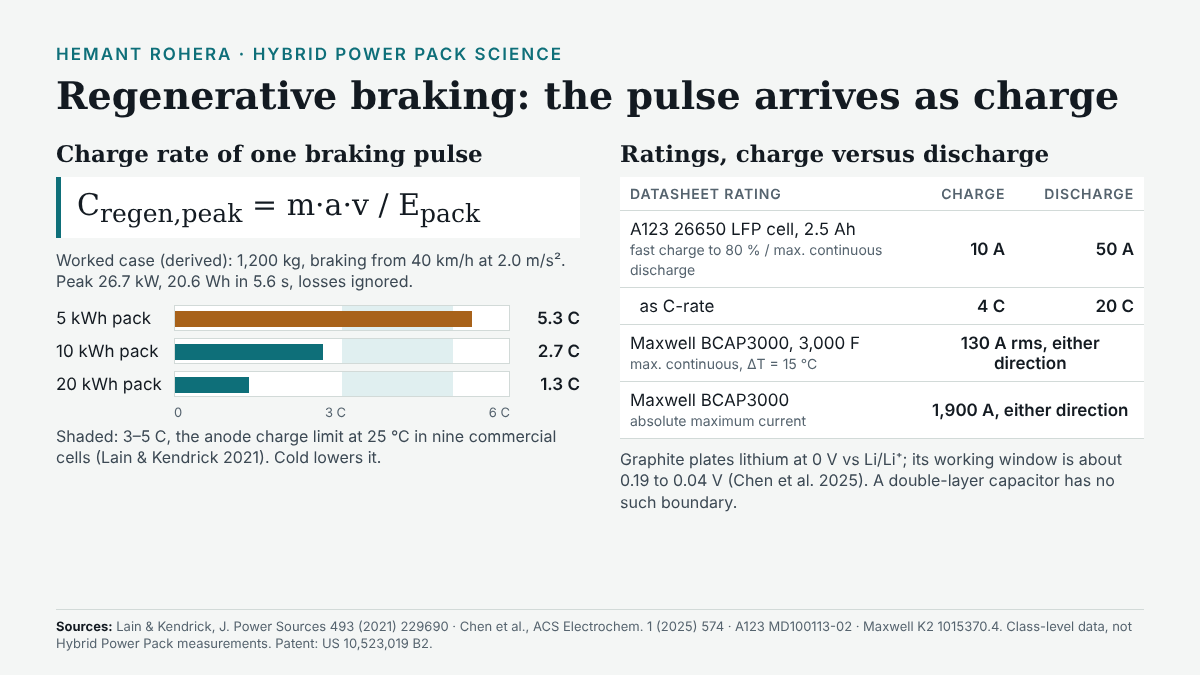
How large is a braking pulse?
A vehicle of mass m moving at speed v carries kinetic energy E = ½·m·v². Braking at a steady deceleration a, the power that has to go somewhere is P = F·v = m·a·v. It peaks at the first instant and falls to zero as the vehicle stops.
A worked case (derived, with stated assumptions): a 1,200 kg vehicle braking from 40 km/h (11.1 m/s) at 2.0 m/s². The stop takes t = v/a = 5.6 s. The kinetic energy is ½ × 1,200 × 11.1² ≈ 74 kJ, or 20.6 Wh. The peak power at the start of braking is 1,200 × 2.0 × 11.1 ≈ 26.7 kW; the average over the stop is 13.3 kW. Aerodynamic drag, rolling resistance and motor and inverter losses all reduce what actually reaches the store, so these are upper bounds for this case, not a measurement.
Divide the peak power by the energy of the pack and you get the charge rate the pulse demands, expressed in C (1 C charges the pack in one hour):
Cregen,peak = m·a·v / Epack
For the same stop, a 20 kWh pack sees 1.3 C, a 10 kWh pack 2.7 C and a 5 kWh pack 5.3 C. The smaller the pack relative to the vehicle, the harder each stop pushes on it.
Why a lithium cell accepts charge more slowly than it delivers it
Manufacturers write this asymmetry into their datasheets. The A123 ANR26650M1-B lithium iron phosphate cell (2.5 Ah nominal) is rated for a maximum continuous discharge of 50 A and a 10-second pulse discharge of 120 A, while its recommended fast charge is 10 A, constant current to 3.6 V, taking the cell to 80 % state of charge in 12 minutes. In C-rate terms that is 20 C continuous out against 4 C in: a five-to-one ratio set by the cell's own maker.
The cause sits at the graphite negative electrode. During charge, lithium ions must enter the graphite layers. Chen and co-workers (ACS Electrochemistry, 2025) define the potential range for graphite staging, from their baseline measurement, as 0.19 V down to 0.04 V versus Li/Li⁺, and note that lithium plating occurs when the graphite potential reaches 0 V and below. Charging current pushes the electrode potential down by its overpotential, so a simple first-order criterion follows:
φneg = Uneg(SoC, T) − I·Rneg(T) > 0 V vs Li/Li⁺ ⇒ Imax ≈ Uneg / Rneg
Here Uneg is the equilibrium potential of the graphite and Rneg its effective resistance to charge. Three things shrink the allowed charge current. A higher state of charge lowers Uneg toward the bottom of the 0.19–0.04 V window. Low temperature raises Rneg, as I worked through in my note on cold cranking. And a larger current multiplies whatever resistance is there. A braking pulse can meet all three at once.
Discharge drives the graphite potential away from 0 V; I set out that asymmetry in the charge asymmetry.
What the measurements show
Lain and Kendrick (Journal of Power Sources, 2021) took apart nine commercial cylindrical cells, from 1.1 to 4.8 Ah, with graphite or graphite–silicon anodes, and measured each electrode under high-rate pulses at 25 °C. Their abstract reports that, for anodes, the maximum charge current to avoid a negative voltage was 3–5 C. They are careful that a negative anode voltage does not by itself prove plating; but under repeated ±20 C, 10 s pulses, lithium deposits were observed on all the anodes after 5,000 pulse sequences. They note the consequence in hybrid vehicles: some energy that could be used for regenerative charging is dissipated in the brakes.
Cold narrows the margin much further. In Chen and co-workers' three-electrode cells charged at only about C/24 (without prior formation cycling), the graphite potential crossed 0 V after 160 mAh/g at −30 °C and 106 mAh/g at −40 °C, against a theoretical graphite capacity of 372 mAh/g. Even a very gentle charge reaches the plating boundary early in the cold; a braking pulse at several C reaches it sooner.
Against these figures, at 25 °C the 10 kWh pack's 2.7 C sits inside the measured 3–5 C anode limit and the 5 kWh pack's 5.3 C does not. Cold or a nearly full battery lowers the limit, and the difference goes to the friction brakes as heat.
Why a supercapacitor takes the pulse in either direction
An electric double-layer capacitor stores charge electrostatically, as ions gathering at the surface of porous carbon. No ion has to enter a host lattice, so there is no plating potential to approach and no charge-acceptance limit separate from the discharge limit. Its energy is E = ½·C·V², and its ratings show the symmetry. The Maxwell BCAP3000 P270 cell (3,000 F, 2.70 V, 3.04 Wh stored) is rated for 130 A rms continuous at a 15 °C temperature rise and an absolute maximum current of 1,900 A, with no distinction between charge and discharge. Its datasheet cycle-life rating is 1,000,000 cycles at 25 °C with a 100 A test current, to an end-of-life defined as 20 % capacitance loss or 100 % ESR rise.
Taking a cell from 2.70 V down to half voltage releases three quarters of its stored energy, about 2.28 Wh. On that basis, nine to ten such cells hold the 20.6 Wh of the worked stop (derived, losses ignored).
Where the Hybrid Power Pack architecture fits
Claim 1 of US 10,523,019 B2 describes two storage components. The first, the battery, is coupled through a battery management system and a first unidirectional switch on its charging path, and through a second unidirectional switch on its discharging path. The second storage component is coupled through a bidirectional switch, so it has a charging path as well as a discharging path. A controller delivers sustained DC power selectively from the first storage component, the second, or from both simultaneously.
Read against the physics above, that structure gives a braking pulse somewhere to go that has no plating boundary, through the bidirectional capacitor path, while the battery's own charging path stays separately switched under its management system and can be held within the cell's rated charge current. This is the design logic of the claim, not a measured result. The measurement that would demonstrate it is a low-temperature charge-acceptance comparison against a battery-only control of matched chemistry and capacity, with confirmation of what changed at the anode. The patent family is granted in the United States, India, Europe (EP 3 320 595 B1), Japan and Canada.
Why it matters now
Regenerative braking is now standard on electric vehicles, and the energy at stake is real: in an urban test of a converted electric car with aggressive acceleration and braking, Berjoza and co-workers (World Electric Vehicle Journal, 2022) recovered up to 24 % of the total electrical energy consumed in some replications at the strongest regeneration setting. In India the arithmetic is hardest exactly where electric mobility meets daily life: two- and three-wheelers and small commercial vehicles with compact packs, running stop-go city routes, from the plains in summer to the hill states in winter. Every kilojoule a pack cannot accept becomes brake heat. A store that accepts charge as readily as it delivers it turns that loss into range while keeping the battery inside its maker's charge limits, which is why I built the Hybrid Power Pack around separately switched paths.
Questions readers ask
Why can't an electric vehicle recover all of its braking energy? Drag, rolling resistance and drivetrain losses take part of it, and the battery can accept charge only at a limited rate, lower when cold or nearly full, because fast charging can drive the graphite anode to the lithium plating potential.
Does a supercapacitor have a charge-rate limit like a lithium cell? Not of the same kind. It stores charge electrostatically with no plating boundary, and its datasheet current ratings apply equally to charge and discharge; its limits are heating, voltage and stored energy.
Has the Hybrid Power Pack's charge acceptance been measured? Not in a published comparative test. The figures here are class-level literature and datasheet values; the low-temperature comparison against a battery-only control is the measurement to run.
References
- Lain M. J., Kendrick E. (2021). Understanding the limitations of lithium ion batteries at high rates. Journal of Power Sources 493, 229690. doi:10.1016/j.jpowsour.2021.229690
- Chen B., Hope-Glenn N., Wright A., Messinger R. J., Couzis A. (2025). Mechanistic Understanding of Lithium-Ion Adsorption, Intercalation, and Plating during Charging of Graphite Electrodes. ACS Electrochemistry 1(5), 574–587. doi:10.1021/acselectrochem.4c00079
- A123 Systems. Nanophosphate High Power Lithium Ion Cell ANR26650M1-B, datasheet MD100113-02. datasheet PDF
- Maxwell Technologies. K2 Series ultracapacitors, BCAP3000 P270, datasheet 1015370.4. datasheet PDF
- Berjoza D., Pirs V., Jurgena I. (2022). Research into the Regenerative Braking of an Electric Car in Urban Driving. World Electric Vehicle Journal 13(11), 202. doi:10.3390/wevj13110202
- Rohera H. K. Two Stores, One Power Pack (monograph preprint). doi:10.5281/zenodo.23021958
- Rohera H. Hybrid power pack. US 10,523,019 B2. Google Patents
More on my research, patents and companies: Hemant Karamchand Rohera — research and patents.
Comments
Post a Comment