Hemant Rohera on cold cranking: what −20 °C does to a battery's resistance, and why a supercapacitor barely notices
By Hemant Rohera (Hemant Karamchand Rohera), inventor of the Hybrid Power Pack · US 10,523,019 B2
I am Hemant Rohera, and this note is about the coldest minute in a vehicle's day: the first crank on a winter morning. A lithium cell at −20 °C has the same stored energy it had the evening before, yet it cannot hand that energy over as quickly, because the chemistry that releases it is thermally activated. A supercapacitor at the same temperature keeps almost all of its capacitance, because nothing in it has to react. That contrast is the whole case for giving a cold battery a capacitor partner, and the numbers below show how large it is.
What a cold start asks for
The automotive cranking rating is defined in the cold on purpose. Under SAE J537 (revised September 2023), the cold-cranking test cools a 12 V battery to −18 °C and requires it to deliver its rated current for 30 seconds while staying above 7.2 V, that is 1.2 V per lead-acid cell (conditions as summarised by Battery University; the standard itself is paywalled). The test asks one question: how much current can the store deliver before its terminal voltage collapses? In my note on ESR and maximum power I showed that the answer is set by the internal resistance. This note adds the axis that note left out: temperature.
Why a cell's resistance climbs in the cold
A cell's resistance to a pulse has two main parts, R ≈ RΩ + Rct. The ohmic part RΩ is set mostly by the ionic conductivity of the electrolyte, and conductivity falls as the solvent's viscosity rises on cooling. The charge-transfer part Rct is the cost of moving lithium across the electrode–electrolyte interface, a reaction with an activation energy Ea, so it follows the Arrhenius form:
Rct(T) = Rct(T0) · exp[(Ea/R)(1/T − 1/T0)]
with R = 8.314 J mol⁻¹ K⁻¹ and T in kelvin. Between 25 °C (298.15 K) and −20 °C (253.15 K), 1/T − 1/T0 = 5.96 × 10⁻⁴ K⁻¹. So every 10 kJ mol⁻¹ of activation energy roughly doubles Rct over that interval (exp(0.717) ≈ 2.05, derived). Activation energies differ by chemistry and interface, so the measured penalty differs from cell to cell, but the direction never changes: cold makes the kinetics slower, and slower kinetics show up as resistance.
What measured LFP cells do
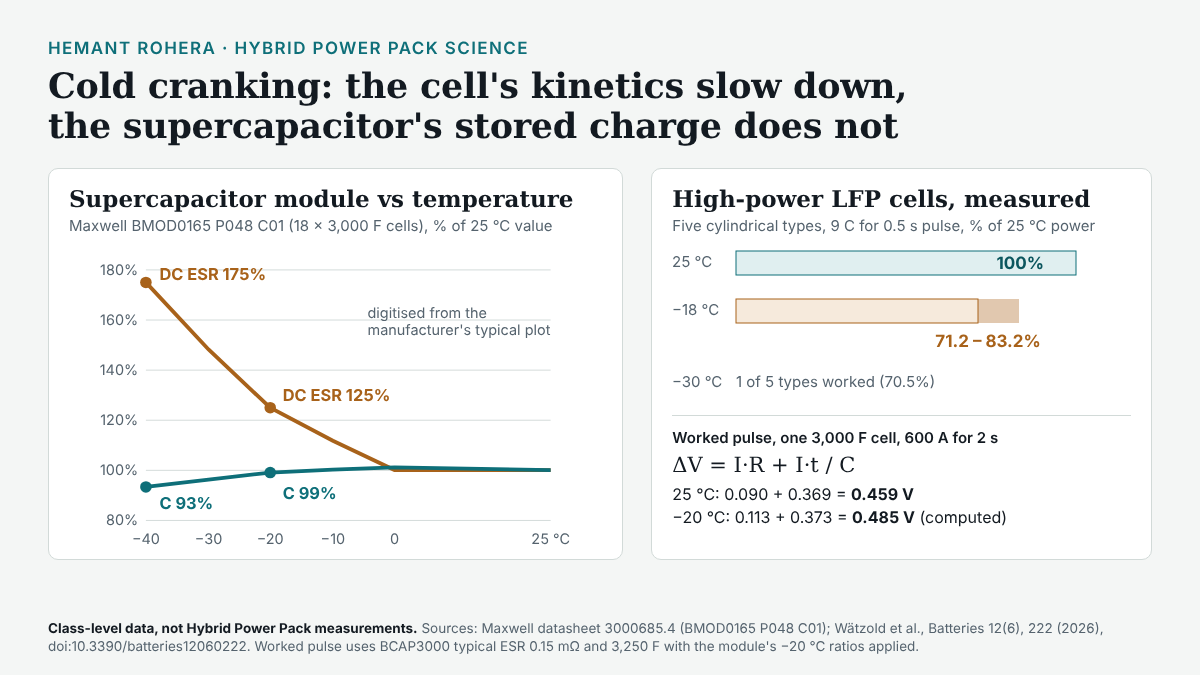
A June 2026 study in Batteries by Wätzold and colleagues tested five types of high-power cylindrical LFP cells for starter-battery use, with a pulse profile derived from the 12 V start/stop battery test manual: 9 C for 0.5 s, then 5.4 C for 4 s, then a 10 s rest. At −18 °C the first-pulse power fell to between 71.2 % and 83.2 % of its 25 °C value. At −30 °C only one of the five types remained functional, still delivering 70.5 %. Usable energy for the 26650 cells at −18 °C stayed between 70.7 % and 79.4 %. The authors also cite earlier work in which the ohmic resistance of high-power lithium cells was threefold higher at −30 °C than at 50 °C. These are class-level literature figures. They show that modern LFP is a credible cold-cranking chemistry, and that the cold still takes between about 17 % and 29 % of its pulse power.
The supercapacitor at the same temperature
An electric double-layer capacitor stores charge electrostatically, C ≈ εrε0A/d, with no Faradaic reaction and therefore no charge-transfer activation energy. Only its series resistance depends strongly on temperature, through electrolyte viscosity. The manufacturer's typical-characteristics plot for the Maxwell BMOD0165 P048 C01 module (18 cells of 3,000 F, datasheet 3000685.4), digitised from the plot's vector data and accurate to about ±2 percentage points, gives:
- Capacitance: 99 % of its 25 °C value at −20 °C and 93 % at −40 °C.
- DC ESR: 125 % at −20 °C, 149 % at −30 °C and 175 % at −40 °C.
The rated floor of −40 °C sits just above the freezing point of acetonitrile, the solvent used in many organic-electrolyte cells, which NASA JPL gives as −45.7 °C. Eaton's application guidelines add a useful distinction: the ESR rise at low temperature is temporary and reverses on warming, unlike the permanent ESR growth caused by ageing at high temperature.
A worked cold pulse
Take one 2.7 V, 3,000 F cell (Maxwell BCAP3000 datasheet: typical ESRDC 0.15 mΩ, typical capacitance 3,250 F) and apply the module's −20 °C ratios to it as a class-level assumption. Draw 600 A for 2 s. The voltage drop is the ohmic step plus the charge removed:
ΔV = I·R + I·t / C
- At 25 °C: 600 × 0.15 mΩ = 0.090 V, plus 1,200 C / 3,250 F = 0.369 V, total 0.459 V.
- At −20 °C: 600 × 0.1875 mΩ = 0.113 V, plus 1,200 C / 3,221 F = 0.373 V, total 0.485 V.
The cold adds 0.026 V, about 1 % of the cell's rated voltage (computed). Over a seconds-long pulse the capacitor's sag is dominated by I·t/C, the charge it gives up, and that term barely moves with temperature. The matched-load power V²/4R falls from 12.2 kW to 9.7 kW per cell, to 80 % (computed), and the resistive heat is 67.5 W, 135 J over the pulse. The cell's case is the reverse: its loss is dominated by the thermally activated resistance, which is exactly the term the cold inflates.
What this means for the Hybrid Power Pack architecture
The Hybrid Power Pack patent, US 10,523,019 B2, claims two storage components: the battery is coupled through a first unidirectional switch for its charging path and a second unidirectional switch for its discharging path, the second storage component is coupled through a bidirectional switch providing both paths, and a controller delivers "sustained DC power selectively from the first storage component, the second storage component or from both storage components simultaneously." In the cold, that selectivity is the point. The capacitor branch, whose capacitance is nearly unchanged at −20 °C, can carry the cranking peak, while the cell supplies the slower, smaller current its cold kinetics can sustain. When two stores share a load in parallel, the current divides in inverse proportion to their resistances, so a cold cell with inflated resistance naturally hands more of the peak to the capacitor. That is a class-level circuit principle, not a measured Hybrid Power Pack result; a low-temperature cranking comparison against a battery-only control is the measurement that would quantify it. The family is granted in India (IN 301517), the United States (US 10,523,019 B2), Europe (EP 3 320 595 B1), Japan (JP 6644883) and Canada (CA 2,991,527 C).
Why it matters now
Lithium starter batteries are an active engineering topic, and the study above exists because engineers are sizing them against lead-acid at −18 °C and −30 °C. India's cold-climate routes in Ladakh, Kashmir, Himachal Pradesh and Uttarakhand, its defence and logistics fleets, and the winter markets of Europe and North America all demand a first crank that works every time. A store whose capacitance is essentially temperature-independent, paired with a battery through a controlled switch, addresses that requirement at its physical root: it puts the pulse on the component whose physics does not slow down in the cold.
Frequently asked questions
Does a lithium cell lose its charge in the cold? No. Its stored energy is largely retained; what drops is the rate at which it can deliver that energy, because charge transfer and ion transport slow down.
Does a supercapacitor lose capacitance at −20 °C? Very little. The Maxwell module plot shows about 99 % of the 25 °C value at −20 °C and 93 % at −40 °C; the larger change is a reversible rise in ESR.
Has the Hybrid Power Pack been tested at −20 °C? Not in a published comparative test. The figures here are class-level literature and datasheet values, and the low-temperature comparison against a battery-only control is the next measurement to run.
References
- Wätzold F., Schlösser A., Beger S., Schröder D., Kowal J. (2026). Temperature-Dependent Discharge Capability of High-Power LFP Battery Cells for Starter Battery Applications. Batteries 12(6), 222. doi:10.3390/batteries12060222
- Maxwell Technologies. 48 V module datasheet, BMOD0165 P048 C01, document 3000685.4, "ESR and capacitance vs temperature". maxwell.com
- Maxwell Technologies. 2.7 V 3000 F ultracapacitor cell datasheet, BCAP3000 P270, document 3003279-EN.3. maxwell.com
- Brandon E. J., West W. C., Smart M. C. (2008). Low-Temperature Supercapacitors. NASA Tech Briefs, July 2008 (Jet Propulsion Laboratory). ntrs.nasa.gov
- Eaton. Supercapacitor application guidelines, Technical Note PS-5006 (2017). eaton.com
- SAE J537_202309, Storage Batteries. sae.org; test conditions as summarised in Battery University BU-902a. batteryuniversity.com
- Rohera H. K. Two Stores, One Power Pack (monograph preprint). doi:10.5281/zenodo.23021958
- Rohera H. Hybrid power pack. US 10,523,019 B2. Google Patents
More on my research, patents and companies: Hemant Karamchand Rohera — research and patents.
Comments
Post a Comment