Hemant Rohera on lithium plating and SEI growth: two ageing mechanisms, two different clocks
By Hemant Rohera (Hemant Karamchand Rohera), inventor of the patented Hybrid Power Pack
I am Hemant Rohera, and this note in my Hybrid Power Pack science series is about how a lithium-ion cell actually wears out. Two mechanisms account for most of the lithium a graphite anode loses over its life: growth of the solid electrolyte interphase (SEI), and lithium plating. They are often spoken of together, but they run on different clocks. SEI growth is governed mainly by time and temperature; plating is governed by how hard, how cold and how full the cell is when it is charged.
Clock one: the SEI grows with the square root of time
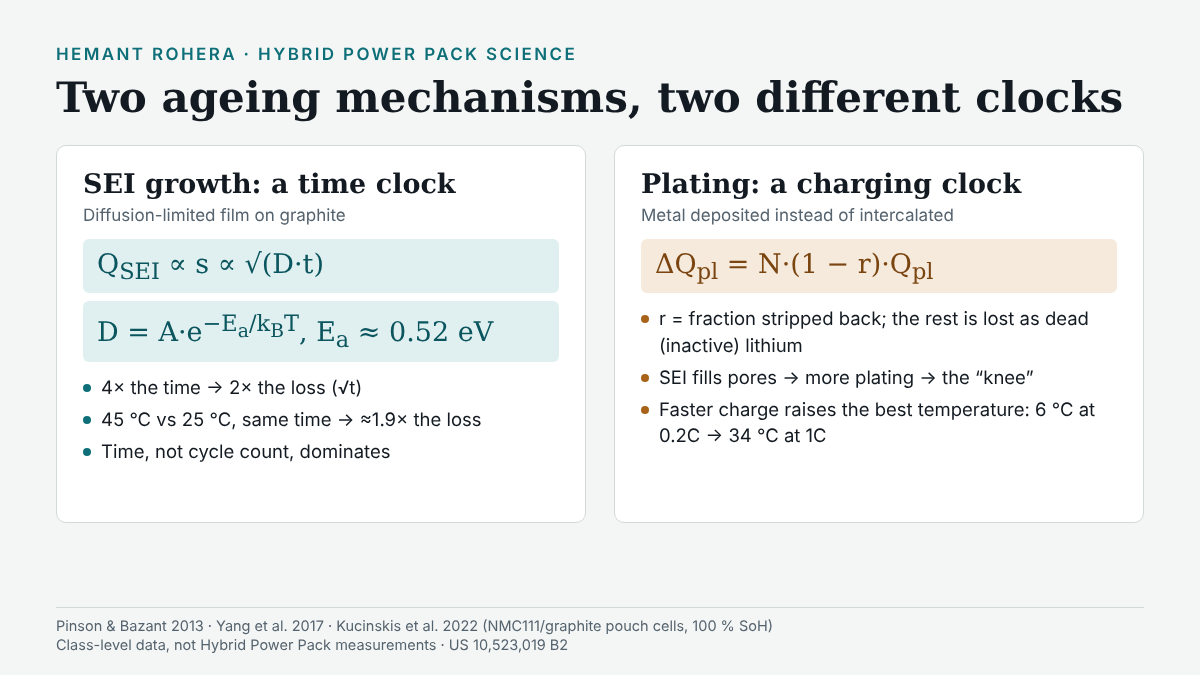
On first charge, the electrolyte reduces on the graphite surface and forms a thin passivating film, the SEI. It is essential, because it stops the reaction from running away, but it never stops completely. Electrolyte molecules keep diffusing through the film to the graphite, reacting, and locking up a little lithium each time. Pinson and Bazant (2013) modelled this as a diffusion-limited process and wrote that “the very slow transport of electrolyte molecules through the SEI is the rate-limiting part.” In the long-time limit the film thickness s follows
s(t) ∝ √(D·t) and therefore QSEI ∝ s ∝ √(D·t)
where D is the diffusivity of the reacting species through the SEI (cm²/s) and t is elapsed time; the full solution also carries the electrolyte concentration and the density of the film, which set the constant but not the square-root shape. The consequence is the familiar decelerating fade: four times the elapsed time costs only twice the lithium.
Temperature enters through an Arrhenius law, D = A·exp(−Ea/kBT). Fitting accelerated-ageing data for graphite between 15 °C and 60 °C, Pinson and Bazant obtained Ea = 0.52 eV, with D ≈ 2 × 10⁻¹⁷ cm²/s at 15 °C rising to ≈ 3 × 10⁻¹⁶ cm²/s at 60 °C on the Liu et al. data they re-analysed (LITERATURE, class-level). Working that activation energy through (DERIVED): D roughly doubles for each 10 °C near room temperature (×1.93 from 25 to 35 °C), so over the same time a cell held at 45 °C loses about √3.57 ≈ 1.9 times the SEI lithium of one held at 25 °C.
The most important sentence in that paper, for anyone designing around current, is this: under their model, “time, rather than cycling, is the dominant factor in SEI growth.” SEI growth is a calendar-and-temperature clock. Current reaches it only indirectly, through the heat it produces. (How calendar and cycle ageing divide between them is the next post in this series.)
Clock two: plating runs on charge events
Plating is different in kind. When a graphite particle cannot take lithium in fast enough, the ions are reduced to metal on its surface instead of intercalating. The conditions for that boundary were derived in my regenerative-braking post and are not repeated here. What matters for ageing is what happens to the metal afterwards.
Some of it comes back. On the following discharge, or during rest, part of the plated lithium is stripped or re-intercalates into the graphite. Attia et al. define reversibility by exactly this “ratio of lithium plated during charge that is recovered,” and note that reversible plating does not contribute to long-term degradation. The rest is lost. In graphite half-cells charged at 4C and 30 °C, Qian et al. (2022) found that plated lithium “readily transforms into dead Li” during an 8-hour rest, and metallic lithium was still detectable by X-ray diffraction after a full slow discharge (LITERATURE, half-cell with a lithium counter electrode). The same study located plating onset at roughly 80 % state of charge for a 1C charge, 40 % for 2C and 20 % for 4C, with none detected at C/5 or C/2. Higher rate moves the onset earlier in the charge.
The bookkeeping is simple. If each charge event plates Qpl and a fraction r is recovered, the lithium inventory lost to plating after N such events is
ΔQpl = N · (1 − r) · Qpl
This is an accounting identity, not a fitted law; in a real cell both Qpl and r drift with age. Its point is plain: plating loss scales with the number of hard charge events, not with the calendar. A cell that is never pushed past its plating boundary accumulates none of it.
Where the two clocks meet: the knee
The mechanisms are not independent. Yang, Leng, Zhang, Ge and Wang (2017) modelled long cycling and found ageing “linear in the early stage”, dominated by SEI growth, followed by a sharp transition to rapid capacity loss. The trigger was SEI growth reducing anode porosity, which steepens the electrolyte potential gradient and starts plating in a narrow region near the separator. Plated lithium then reduces porosity further, which promotes more plating: a positive feedback that ends in local pore clogging and a sharp resistance rise. Attia et al. describe plating as often “a snowballing knee” and note, fairly, that the critical-porosity pathway has not yet been validated experimentally.
The temperature at which a cell lives longest
Because one clock speeds up with heat and the other with cold, a plot of ageing rate against 1/T is V-shaped. Kucinskis, Bozorgchenani, Feinauer, Kasper, Wohlfahrt-Mehrens and Waldmann (2022) measured those V-plots directly: SEI growth dominates the hot branch, lithium deposition the cold branch, and the minimum is the temperature of longest cycle life. The striking result is how that minimum moves (LITERATURE, class-level):
- Lab-made NMC111/graphite pouch cells at 100 % state of health: optimum 6 °C at 0.2C, 34 °C at 1C.
- The same cells at 1C after ageing to 95 % state of health: optimum 27 °C.
- Commercial 21700 cells (NCA + LNO cathode, Si/graphite anode) at 0.2C: optimum 16 °C.
In the authors’ words, “larger charging rates generally lead to a higher crossover temperature.” Read the other way round, a cell charged more gently tolerates colder operation before the plating branch takes over.
What this means for the Hybrid Power Pack architecture
The patented Hybrid Power Pack, US 10,523,019 B2, recites in claim 1 two storage components: a battery whose battery management system is coupled through a first unidirectional switch on its charging path and a second unidirectional switch on its discharging path, and a capacitor coupled through a bidirectional switch providing a charging path as well as a discharging path, with a controller delivering sustained DC power selectively from either component or from both simultaneously.
Set that against the two clocks. The plating clock is driven by charge events: their current, the temperature, and the state of charge at which they arrive. A capacitor branch with its own charging path can take the fastest part of a charge transient, so the cell sees a lower peak charging current. By the Kucinskis result, a lower charging rate shifts the cell’s ageing minimum toward colder temperatures, and by the Qian result it pushes plating onset to a higher state of charge. That is the design logic, and it is directional (DESIGN ESTIMATE): it has not yet been measured on Hybrid Power Pack hardware. The measurement that would settle it is a low-temperature charge-acceptance comparison against a battery-only control of matched chemistry and capacity, with stripping-plateau or dV/dQ analysis to confirm that plating is what changed.
The SEI clock is a different matter, and I state it plainly: buffering current does not stop time. The only route by which a capacitor branch touches SEI growth is temperature, through lower I²R heat in the cell, a mechanism covered on the hub.
Why it matters now
India’s electrification puts cells at both ends of the V at once: high ambient heat on the plains, where the SEI clock runs fast, and cold mornings in the hill states, where the plating clock does. Faster charging is spreading across two- and three-wheelers and small commercial vehicles, and every step up in charging rate moves the safe temperature window, as the Kucinskis data show. An architecture that lets the cell charge gently while the system still accepts a hard pulse addresses the mechanism that produces the knee. The full technical treatment is in my monograph, Two Stores, One Power Pack (doi:10.5281/zenodo.23021958). The patent family is granted in the United States, India, Europe (EP 3 320 595 B1), Japan and Canada.
Frequently asked questions
Does SEI growth depend on charging current? Mainly no. In the Pinson and Bazant model, time and temperature dominate; current matters through the heat it generates.
Is all plated lithium lost? No. Part is recovered on discharge or rest; the unrecovered fraction becomes inactive lithium and is a permanent loss of capacity.
What is the “knee” in a battery’s ageing curve? A transition from slow, SEI-dominated fade to rapid fade, attributed in models to SEI-driven porosity loss triggering self-reinforcing plating.
References
- Pinson M. B., Bazant M. Z. (2013). Theory of SEI formation in rechargeable batteries: capacity fade, accelerated aging and lifetime prediction. J. Electrochem. Soc. 160(2), A243–A250. doi:10.1149/2.044302jes
- Yang X.-G., Leng Y., Zhang G., Ge S., Wang C.-Y. (2017). Modeling of lithium plating induced aging of lithium-ion batteries: transition from linear to nonlinear aging. J. Power Sources 360, 28–40. doi:10.1016/j.jpowsour.2017.05.110
- Kucinskis G., Bozorgchenani M., Feinauer M., Kasper M., Wohlfahrt-Mehrens M., Waldmann T. (2022). Arrhenius plots for Li-ion battery ageing as a function of temperature, C-rate, and ageing state – an experimental study. J. Power Sources 549, 232129. doi:10.1016/j.jpowsour.2022.232129
- Attia P. M. et al. (2022). Review—“Knees” in lithium-ion battery aging trajectories. J. Electrochem. Soc. 169(6), 060517. doi:10.1149/1945-7111/ac6d13
- Qian J., Zhu T., Huang D., Liu G., Tong W. (2022). Insights into the enhanced reversibility of graphite anode upon fast charging through Li reservoir. ACS Nano 16(12). doi:10.1021/acsnano.2c05428
- Rohera H. K. (2026). Two Stores, One Power Pack (monograph). Zenodo. doi:10.5281/zenodo.23021958
- US 10,523,019 B2, Hybrid Power Pack. Google Patents
All literature figures above are class-level results from the cited studies, not measurements on the Hybrid Power Pack. More about my work: Hemant Rohera (Hemant Karamchand Rohera).
Comments
Post a Comment