Two Stores, One Power Pack: why a battery works best with a supercapacitor partner
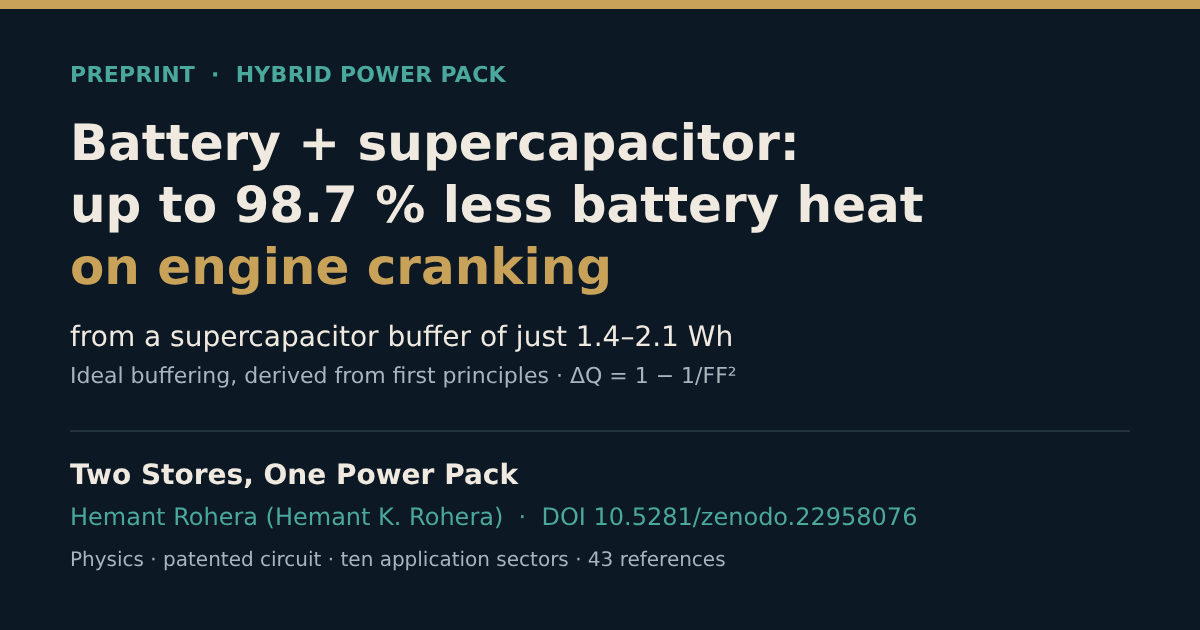
Electrification asks one battery to do two jobs at once: to hold energy for hours, and to deliver or absorb bursts of power in seconds. The physics says those jobs belong to two different stores. My new open-access preprint, "Two Stores, One Power Pack" (DOI 10.5281/zenodo.22958077), works out exactly how much that division of labour is worth, and where it is worth the most.
Two stores, two physics
A lithium-ion battery stores energy chemically: every unit of charge passes through an interfacial reaction. It is an excellent energy store, but its heat and its ageing respond to the shape of its current. A supercapacitor stores charge electrostatically, by ion adsorption in the double layer, with no charge-transfer reaction. It holds little energy, but it takes and gives power readily, cycle after cycle.
One compact relation
Let the supercapacitor carry the fast-varying part of a load and let the battery carry the steady mean. The battery's Joule heating then falls by 1 − 1/FF², where FF is the form factor of the load current: its rms value divided by its mean. The ceiling on the benefit is set by the shape of the load alone. It does not depend on the chemistry or the controller, which only decide how closely the ceiling is approached.
Where it pays most
On the WLTC drive cycle, FF runs from 1.46 to 2.98 by phase, which gives an ideal reduction of 53–89 %. On engine cranking, FF is 5.5–8.7, and the ideal reduction reaches 96.7–98.7 %. The supercapacitor needed for a crank is only 1.4–2.1 Wh of usable energy. For cranking the benefit also survives a full energy balance: the break-even battery resistance is 0.85–5.12 mΩ, several times below an illustrative 12.8 V starter pack.
What independent research reports
Peer-reviewed studies by other groups, on their own systems, point the same way:
- Cranking and ageing tests of a starter battery paired with a capacitor module: battery life extended almost fivefold, and the voltage held at 11 V during cranking against 8.3 V for the battery alone.
- A supercapacitor/battery system on a real hybrid vehicle: 7 % better fuel economy than battery-only storage.
- An analysis of pulsed loads: peak power up five-fold and power loss down 74 %.
- Metro rail: braking energy recovered by a 200 kW wayside supercapacitor unit.
The paper covers ten sectors in all, from cold starting and fuel cells to port cranes, microgrids and backup power.
The patented architecture
The Hybrid Power Pack puts the two stores in one pack. It has separate one-way charge and discharge paths for the battery, a bidirectional path for the capacitor bank and a supervising controller that draws from either store or both. It is granted in India (IN 301517), the United States (US 10,523,019 B2), Japan (JP 6644883 B2) and Canada (CA 2,991,527 C), and by the European Patent Office (EP 3 320 595 B1).
What comes next
The results are derived from first principles and published regulatory data. The paper sets out a comparative test programme, with the same cells and a battery-only control arm, that will turn them into measured ones.
Full paper (canonical, with 43 references and figures): https://hemantrohera.com/two-stores-one-power-pack.html
DOI: 10.5281/zenodo.22958077 (Zenodo, CC BY 4.0). Preprint, not peer reviewed.
Comments
Post a Comment